Microsoft is planning to release its Windows 10 operating system in
the summer. While the software maker isn’t naming an exact date, Windows
chief Terry Myerson is committing the company to a summertime launch
today. "We continue to make great development progress and shared today
that Windows 10 will be available this summer in 190 countries and 111
languages," says Myerson. Microsoft is making Windows 10 available as a free upgrade for existing Windows 7 and Windows 8 users for a year, and that offer will start this summer.
As part of Microsoft’s upgrade plans, the software maker
is partnering with Lenovo and Tencent to offer Windows 10 in China.
Lenovo will have Windows 10 upgrade services at 2,500 service centers
and some retail stores in China. Tencent is also offering an upgrade
pack with a variety of popular apps including QQ. Both partnerships are
clear moves by Microsoft to make Windows available in China, and a way
to combat issues of software piracy in the region. Microsoft is even
offering its Windows 10 upgrade to customers who have non-genuine copies
of Windows. That’s a big change to Microsoft’s previous attempts to
tackle software piracy in China.
Google's wind turbines don't look like the ones you might see along
the US coastline. They're more like "planes" equipped with eight
propellers that are tethered to a docking station.
When they're
released, they get up to 450 meters in the air. At that altitude, the
plane starts doing large circles in the sky, which turns the plane's
propellers. The drag turns each of the eight propellers into individual
turbines that send 600 kilowatts back down to Earth.
Google has been working on wind turbines for some time now,
thanks in part to its purchase of the energy company Makani Power in
2013. But the turbines it has flown so far measured 28 feet in length.
The one that Google plans to fly next month will measure 84 feet, Teller
said, which means it might be equipped with additional propellers.
"if you're not breaking your experimental equipment... you could be learning faster."
Astro Teller told the crowd today that the company has flown the
smaller versions in the harshest of wind environments.
"Larry Page said
to me, 'make sure you crash at least five of those test versions,'"
Teller said. "What he meant was... if you're not breaking your
experimental equipment, at least some of the time, you could be learning
faster. And I know
he's right."
To test the turbines, the team went to one of the windiest places in
North American — Pigeon Point in Pescadero, California. The speed of the
wind can change by 20 miles per hour in a second, and the direction of
the wind can change by 90 degrees in a second, Teller said. But the
turbines didn't crash. "We failed to fail. We didn't crash, not once."
7 out of 10 girls are interested in science. Only 2 out of 10 will
pursue it as a career. Let’s change that. Through the voices of these
girls, we celebrate International Women’s Day and Women’s History month.
We support the bright young women who participated in this project and
all girls who share our belief in the empowering nature of science and
technology.
Microsoft is committed to creating opportunities for
all youth. DigiGirlz is a Microsoft YouthSpark program that gives girls
the opportunity to learn about careers in tech. Learn more about it
here: http://msft.it/digigirlz
Adonit makes some of the best iPad styluses out there, and now it's starting to make an iPad drawing app to help you sketch with them. The app, called Forge,
is being released today. It's specifically designed to work with
Adonit's pressure-sensitive Jot Touch stylus, but it'll work with any
generic stylus and even your finger, too.
Forge is set up to let you iterate on designs and ideas
Forge is a fairly straightforward drawing app with five tools, a
quick color selector, and most of the screen left empty for you to
sketch on. All of the tools work well and do a good job of translating
your marks into smooth and stylish lines, especially when you're using
the Jot Touch. Forge's interface has a minimal aesthetic that tries to
streamline the process of getting you from opening the app to starting
to draw — it should look really familiar to anyone who's used Adobe's
Line and Sketch apps before. For the most part, it's as simple as you
want it to be while still allowing you to quickly change brush sizes and
adjust your color choices.
Microsoft is revealing today that it plans to kill off Google and Facebook chat from its Outlook.com email service "within the next couple of weeks." In an email to Outlook.com
customers, Microsoft says it’s removing Google Talk integration "due to
Google’s decision to discontinue the chat protocol used by the Google
Talk platform." Microsoft will also be discontinuing support for
Facebook chat in Outlook.com, but the company has not revealed why it’s killing off the social network’s chat integration.
Facebook and Google services for Outlook.com
also integrate with the people feature of the webmail service and keep
contacts up-to-date, and Microsoft says this feature will be unaffected
by the decision to discontinue the chat options. Microsoft’s Google Talk
support in Outlook.com was a highly requested feature shortly before the software maker introduced it in May 2013. Microsoft is now pushing customers to use Skype in Outlook.com, in a move that feels similar to the retirement of the Windows Live Messenger service back in late 2012. Both Google and Facebook services will disappear from Outlook.com in the coming weeks.
The preview version of Windows 10 for phones will reportedly be released in a couple of days.
Nokiapoweruser had
earlier reported, via its sources, that the technical preview for
phones will be released within 2-4 weeks from 21 January, which is
opposed to Microsoft's given schedule for late February.
A new disclosure from an anonymous tipster, quoted by the site, now
asserts that the first preview build of Windows 10 for phones will be
out on the 4th of February. Considering this release timing is too
early, take this information with a pinch of salt.
There is a good
chance that Microsoft might release the preview build soon, as only a
few days ago Microsoft had pushed out an update for the 'Phone Insider'
app that will allow registered Insiders to receive pre-release OS
updates on their phones.
The name of the app is now 'Windows
Insider' which hints that Microsoft is planning to have the Windows name
across all platforms of Windows 10.
The update for Windows
Insider now offers users the option of logging in with their Microsoft
account, after registering as a Windows Insider. If you have already
registered for your Windows 10 desktop, you are ready to go.
The
download link for the Windows Insider app is provided below. When you
try installing the app, you will be greeted with a message that reads,
"We were not able to find a preview build," and about the 'system
requirements'. This, however, will not be an issue as the app will
support all Windows Phone 8 and Windows Phone 8.1 devices, though you
need to be running the latest build of Windows Phone 8.1.
Samsung and Google may have gotten the ball rolling with Gear VR and
Cardboard, but head-mounted 3D isn’t done there; at today’s Windows 10
event, Microsoft announced its next-gen augmented reality system,
Windows Holographic.
The hugely ambitious project will draw on APIs introduced in Windows
10 to give developers the tools they need to allow users to interact
with virtual displays that seem to seamlessly blend into the world
around them.
Of course, you need some advanced hardware to pull of a feat like
that, and for this Microsoft has its own HMD, the Microsoft HoloLens
wearable computer.
The hardware is a self-contained system, not relying on an external
phone or PC. It’s got its own CPU, GPU, and a custom “holographic”
processor. Images will be displayed on a translucent visor, letting
HoloLens overlay its output on your visual field.
Microsoft’s demonstration of the Windows Holographic interface shows
how HoloLens is able to track a user’s hands in real time, allowing them
to interact with its “holograms” without the need for dedicated input
hardware. Voice command allows for even finer-grained input.
Sound like something out of a sci-fi movie? You’re not too far off,
and Microsoft’s been with working with none other than NASA on
developing HoloLens and its Windows Holographic tech.
"We're not talking about putting you into virtual worlds. We're dreaming beyond virtual worlds."
Microsoft has just revealed its next great innovation: Windows
Holographic! It's an augmented reality experience that employs a
headset, much like all the VR goggles that are currently rising in
popularity, but Microsoft's solution adds holograms to the world around
you. The HoloLens headset is described as "the most advanced holographic
computer the world has ever seen." It's a self-contained computer,
including a CPU, a GPU, and a dedicated holographic processor. The dark
lenses up front contain a see-through display, there's spatial sound so
you can "hear" holograms behind you, and it also integrates a set of
sensors. HoloLens, says Microsoft, will be available in the Windows 10
timeframe.
Microsoft is preparing to preview its latest version of Windows Phone later this month. The software giant released a "Phone Insider" app
over the weekend, ahead of a January 21st press event where the company
will reveal its plans for Windows 10 across phones and tablets. Sources
familiar with Microsoft’s plans tell The Verge that the company
will demo a number of features aimed at Windows 10 on phones, including
some user interface changes designed to more closely align its mobile
operating system with its desktop counterpart and the Xbox One games
console.
Microsoft is also making changes to Windows 10 on the desktop to include light and dark themes that
match the phone and tablet editions. Currently referred to as Windows
Mobile and Windows 10 Mobile internally at Microsoft, the next mobile OS
will be a combination of the Windows Phone and Windows RT operating
systems. Microsoft is aiming to take advantage of its universal
applications model to align its tablet and phone software to run the
same apps across tablets and phones. While the company will detail its
developer and app plans further at Build, the January 21st event will focus more on the consumer features
of both the desktop and phone / tablet operating system. Microsoft may
even choose to name its new combined Windows RT and Windows Phone OS at
the event.
Windows 10 for phones preview expected by end of January
The recently released "Phone Insider" app provides similar
access to the Windows 10 insider program, allowing enthusiasts and
partners to test an early version of Windows 10 for phones. While the
app only works for Microsoft employees at present, we understand
Microsoft will be expanding its use to allow anyone to sign up and
install Windows 10 on modern Windows Phones. Like the Windows 10 insider
program, the initial preview for phones will be limited in features as
the company seeks feedback on changes ahead of a release later this
year. Microsoft is expected to release the Windows 10 for phones preview
by the end of January, following the press event on January 21st. The Verge will be live from Microsoft's press event next week, stay tuned for more details on our live blog plans.
A quick look at the Local Motors Strati
might elicit a reaction like, "why does it look like it's made out of
Rubbermaid garbage cans?" It's a fair question — continuous tubes of
dull black plastic outline virtually every major component of this car
in places where you'd normally expect bright, shiny colors. Metal.
Chrome. Pretty stuff.
There's a good explanation, though: the Strati is basically willed
into existence by an enormous 3D printer that extrudes those lines of
plastic making up the car's frame. After that, it's refined using a CNC
milling machine, a few mechanical bits are slapped on, and boom, you
have a running car.
Local Motors is in the process of assembling a Strati
here at the North American International Auto Show, but in the
meantime, I had a chance to ride around in one of the company's older
prototypes. It's not fast, but the electric drivetrain is definitely
quiet and the car comfortably seats two — think of it as a big go-kart.
I'm not sure I'd buy one, but I'd certainly print one.
The first truly wireless earbuds are here, and they're awesome
Every few months I boot up my Google
machine and search for "wireless earbuds." I have great over-the-ear
headphones that I love, but there are just too many times when I need
something more portable. That forces me to deal with problems like
durability and fit, and the fact that the wires on every pair of earbuds
seem to fail, like clockwork, every six months. My search always yields
results, but never the ones I'm looking for.
I want the wires gone.
I'm sick of them, and I don't want a pair of "wireless" ones that
wrap around the back of my head. I want really, truly wireless earbuds.
Basically, I want these:
Ryan Reynolds knows what's up
That is the GIF that David Pierce and I passed back and forth to each
other after he got our Moto Hint review unit in. (It's also become the
reference point for nearly the entire internet when it comes to the concept of wireless earbuds.) The Hint wasn't our favorite device,
but it fit in my ear so well that my desire for a pair of wireless
in-ears skyrocketed over the last few months. It's taken a long time to
get here, but a few companies showed up at CES with some production
models that are nearly ready to hit the market in 2015. I set out around
Las Vegas to give them a listen.
Bragi Dash
The best headphones I tried — and the ones I'll be tempted to buy as
soon as they are available — were the touch-enabled Bragi Dash
headphones. They are exactly what I've wanted. The seal and the friction
from the rubber keep the buds in place and are surprisingly
comfortable, and they're light enough that they don't feel like they
would pull themselves out.
That's no surprise, because the company is run by the former head of
design at Harman Kardon, and the COO was a senior VP at Jabra. In the
two years they spent building the Dash, the Bragi team used ear molds
acquired from hearing aid companies. They also 3D-printed prototypes
specifically to fit those molds, opting not to use the less-precise
method of injection molding. There's even a cool charging case that can charge them up to five extra times.
The music I listened to sounded great, even though I was surrounded
by the din of the Sands convention center. The noise canceling was a
little too noticeable, but otherwise I was impressed by the depth and clarity. It's more than just an earbud
The Dash is meant to be more than just an earbud, a trend I found was
common with these early-to-market companies. As CEO Nikolaj Hviid told
me, the Dash is also supposed to be an assistant. Not only does it have
fitness sensors, but the built-in accelerometer can allow for gestures —
or "macros" as Bragi calls them. By tilting your head up, for example,
you could have a voice read you the weather forecast. If a call comes
in, you could nod to answer or reject it. Those macros can be swapped,
disabled, and programmed to other functions, too. Eventually Bragi wants
them to be able to work independently instead of with your phone over
Bluetooth.
Bragi is aiming to ship in April, and the Dash headphones will cost $299 in Europe and through online retailers.
FreeWavz wireless headphones
I've never really wanted more functionality from my headphones, but
it was hard to find any devices here at CES that didn't have some sort
of fitness tracking. Freewavz has totally embraced it: its earbuds are
like the sport headphones we've seen for years, with plastic curving
over the top and around the back of the ear to keep them snug during
workouts.
Like Dash, FreeWavz uses a mix of sensors to track and analyze your
activity. They will sample things like your heart rate up to 500 times
per second, which would be way past the rate of many fitness bracelets.
Outside of that, the finished product will have a bunch of other
features like noise canceling, adjustable frequency levels, and
text-to-speech. The more polished versions of the FreeWavz prototype
What I tried from FreeWavz was even more of a prototype than what
Bragi had on hand — the working unit was 3D-printed and felt a little
frail. But CEO Mike Kahn told me that the production version should
weigh about the same, which would be wild: these headphones were very
light. When I listened to music through them they sounded good enough,
but could fare better away from the noise in the hall. The company had a
more finished design in the Innovation Awards section, and I have to
admit the renders
of the version they want to ship in April look really beautiful.
They'll cost $249.99 then, but are available for preorder now for $30
less. Kahn said they hope to get them to retailers and sporting goods
stores as well.
HearNotes
The last wireless headphones I saw this week were from a company
called HearNotes. While they had the most polished-looking setup
compared to Bragi and FreeWavz, it was the one company that wouldn't let
me try the headphones on. Still, should the product make it to market
for its estimated $349 price, there are some interesting ideas behind
it: the headphones are supposed to work over Kleer wireless, which is
supposed to allow for lossless transmission. They're also supposed to
wirelessly charge within four feet of the carrying case. There's no
fitness tracking here; the focus is strictly on audio.
We've only just begun
The good thing is that what I saw at CES is only the beginning. Just
this week, another company popped up on my Google machine called Earin,
and it too looks like what I had originally set out to find — simple,
wireless earbuds. Its model is in pre-production now but is aimed for an
early 2015 release, similar to the time frame for the companies here at
CES.
Until then, Bragi has my attention, and FreeWavz looks like it could
be a great option for more fitness-minded people. If these devices can
actually make it to market, there's no doubt 2015 will finally be the
year of wireless earbuds.
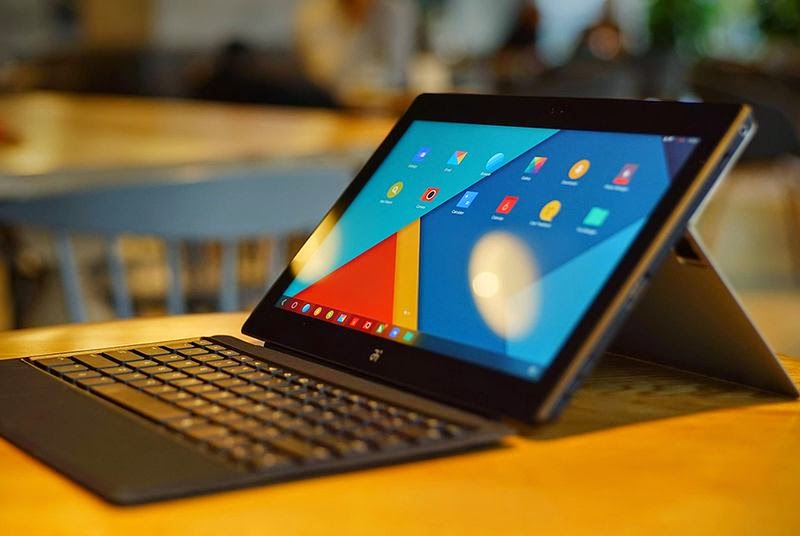
Microsoft’s Surface tablet has inspired a few clones
during its short history, but the latest rip off comes from three
ex-Google engineers. Jeremy Zhou, David Ko, and Ben Luk used to work on
products like Google Maps and search at the web giant, and formed Jide
Technology in 2014 to create a combined tablet and laptop. The result is
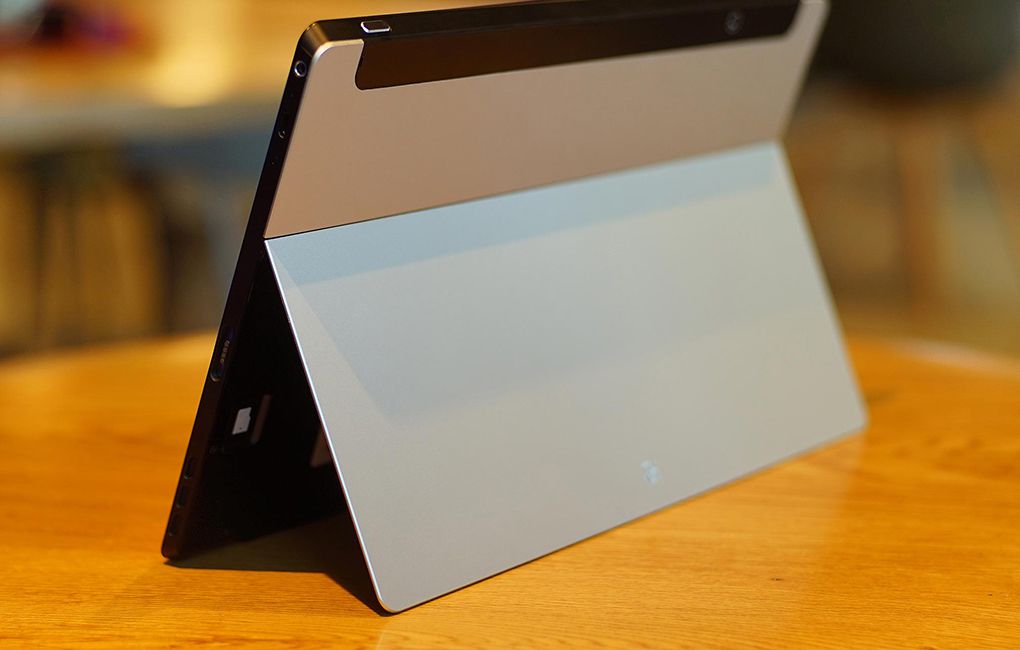
an "ultra tablet" with
a magnetically attached keyboard and a kickstand that all looks
identical to Microsoft’s Surface tablet. Jide Technology hasn’t just
stopped at the hardware, though. Even the "Remix OS" rips off
Microsoft’s work in various ways, including a mail client that’s a
straight copy.
So what’s the justification for such a blatant rip? "We
can't stand the drawbacks of the tablets and laptops on the market today
and we wanted to do something about it," reads a statement on the
company’s site. Jide’s creation is an 11.6-inch tablet that runs a
modified version of Android that takes a lot of design cues from
Lollipop and Microsoft’s "Metro" design language. Specifications include
a 1920 x 1080 display, 2GB of RAM, and an Nvidia Tegra 4+1 processor. Android Central got a quick look
at the tablet at CES this week, and notes that it also includes a 4-pin
charging connector at the side and support for multiple windows with
Android apps.
Jide plans to launch the Remix tablet in the US this year
priced at $349 for the basic 16GB model, but we have a feeling Microsoft
might have something to say about it.
Sony's push into Android could be great news for everyone but Sony
Sony should be unstoppable. No other
company has such a potent mix of content, brand cachet, and hardware
design in multiple areas. But the story with Sony for well over a decade
has been its ineptitude at bringing all these things together to form a
coherent whole.
CEO Kaz Hirai acknowledged this when taking over in early 2012,
presenting a strategy called “One Sony” in an attempt to unify and
streamline the company’s businesses. But that followed previous chief
Howard Stringer’s “Sony United” concept; the dream of a slick machine
that can draw on the best of each division is a unicorn that the company
continues to chase.
At CES 2015, Sony’s predicament remains clear. Almost nothing in
their gargantuan booth appears to be a bad product. There are gorgeous
TVs, a thriving game platform, some of the most advanced cameras in the
world, and much more, yet the connective tissue between all of this is
little stronger than in years before. However, there’s a new wildcard
that could have serious implications for Sony’s ecosystem: Google.
Sony’s SmartWatch 3 improves on its predecessor in some minor ways — the new metal band
feels better than most, and its integrated GPS chip makes it less
reliant on a tethered smartphone — but the biggest difference is its
software. The latest model runs Android Wear, Google’s new operating
system for wearables. The story’s the same with Sony’s 2015 TVs: every set will run Android TV
rather than the proprietary software on prior models. But unlike
Android on phones, hardware companies can’t adapt Android Wear or TV;
what Google gives is what Sony gets. "We looked at it and said people want to be familiar with their device," says Phil Jones (pictured below),
product information manager for TVs at Sony. "They want to be able to
walk up to their TV and within a minute be able to use it. Google
Android devices have dramatic marketshare — it’s like 80 percent of the
phones worldwide use this operating system. Even if you’re an iOS person
you probably have a Chromecast, or you have some sort of relationship
with Google. So people are familiar, and what is familiar becomes
simple." Sony has linked up with Google initiatives in the past, of course —
its first Android phone was released in 2010, and it was one of the
biggest backers of the ill-fated Google TV project. But Android TV is a
simpler system far more likely to succeed, and Android Wear has much
more momentum. From the consumer’s point of view, it’s probably for the
best that Sony is abandoning its often clunky home-baked solutions. And,
with the sale of VAIO, the company has severed its ties to Microsoft
and gone all-in with Google as a third-party software provider. All of
this is great news for Google, which will get some of the most
attractive vessels for its services yet.
The problem for Sony is that a Sony smartwatch is now functionally
the same as an LG or Samsung or Motorola smartwatch. A Sony TV now runs
the same interface as a Sharp or Philips TV, or any other set with an
Android TV-compatible box plugged in. Unlike with phones, where the
likes of Samsung and HTC were allowed to run wild and customise Android
to their own benefit, Google has adopted a stricter attitude to what
Android looks and feels like on other types of device. With the Google partnership, Sony’s business model is even more
reliant on wooing customers with beautiful hardware and high
performance; a risky strategy in the current consumer tech landscape.
Will anyone really feel compelled to buy a Sony TV or watch to match
their phone when competing products run the exact same software? If
Sony’s financial results over the past few years are anything to go by,
the company’s undeniable knack for design isn’t the silver bullet it
once was. "Maybe we could’ve built our own infrastructure," says Jones. "But
what is the center of the house? For some people it’s TV, some people
that’s the tablet, and for some people it’s the phone. But for all those
things, the other two devices are running on Android for most people.
Why not make sure that, regardless of whether the TV, the tablet, or the
phone is the hub, that Google connects them?"
Well, Sony has a lot more than three product categories. Take the new audiophile-focused Walkman ZX2.
On one hand, it feels like a return to the old Sony spirit; let’s
engineer an amazing, niche device, sell it for nearly $1,200, and see if
anyone bites. But it runs 2012’s Android 4.2, and the basic interface
is laggy beyond belief. I asked Xperia product marketing manager Stephen
Sneeden if Sony’s mobile team had any input into the new Walkman’s
design, and he said that the device was outside his purview. The ZX2
doesn’t feel like a product of One Sony; it’s a product created by one
of many Sonys.
The ZX2 isn't a product of One Sony; it’s a product from one of many Sonys The PlayStation 4 is another example. It’s an excellent, popular
games console, but Sony’s woes with building out PlayStation Network
have been well documented, and the company’s gaming devices still don’t
interact much with other products. While there’s a rudimentary
PlayStation app that lets you check your profile and takes you to a web
store, and Xperia phones are starting to allow streaming from
PlayStation Now, that’s about as far as it goes. A powerful $399 box
connected to the TV could be the center of any product lineup, but Sony
seems content to sequester it away as a curio separate from the rest of
its devices. That dissonance is only going to get worse as the reliance
on Google takes hold.
Sony has made efforts to unify its strategy. "When you’re a big
company it’s easy to become siloed, and we’re working really hard not to
be siloed and to communicate so our products work seamlessly together,"
says Jones, who notes that he now works in the same buildings as people
from other divisions rather than having to go to another office
"literally a mile away." Jones also cites examples where knowledge has
been shared to improve products on a technical level; the company’s 4K
TVs, for instance, use image processing technology informed by the
output from its professional 4K movie cameras. "That experience of
making the cameras, making the content, displaying it in 4K, helps us
make a better TV," says Jones. "Because everybody else, this is their
first time at the rodeo. We’ve been doing it for a while, and we can do a
better job of it."
The thing is, Sony seems to think that Google can do a better job of
the cloud infrastructure that customers have come to expect. And it’s
almost certainly right. But the trouble with bunting to Google is that
there’s little room for Sony to innovate or leverage the things it has
that no-one else can offer. The company’s most eye-catching successes
have been in divisions that Google has little to do with — cameras,
gaming, image sensors, movies. What could be a more illustrative example
of Sony’s ecosystem woes than The Interview — a movie from its own
studio — coming to Xbox and Google Play before the PS4? It’s as if Sony
has given up on its role as a content provider.
The shift to Android software will make Sony TVs and watches better
in the short term, but it’s far from a forward-looking strategy. As Sony
itself has said repeatedly over the years, it needs to pull itself
together if it’s ever going to realize its potential. But the vision at
CES is for several Sonys, and the most important one is Google.
Microsoft is preparing to unveil a new browser in Windows
10, codenamed Spartan, and leaked images are providing an early glimpse
at the Internet Explorer successor. Chinese site Cnbeta has published screenshots showing the simple interface of Spartan and the Cortana digital assistant integration. The Verge revealed yesterday that Spartan will include digital inking support to share and annotate web pages, and deep Cortana integration in the address bar and throughout the browser.
Cnbeta’s screenshots also reveal Microsoft’s upcoming Windows 10 user interface. Sources familiar with Microsoft’s Windows plans tell The Verge
that the company is planning to build light and dark themes with color
accents for Windows 10. The look and feel will be similar to that of the
existing user interface for Windows Phone, and these leaked screenshots
provide an early look at an internal Microsoft concept and the aim for
the final UI. They do not represent the final interface as Microsoft
will be tweaking it a number of times over the coming months. Some of
these user interface changes have started appearing in recent builds of
Windows 10, with the new dark taskbar surfacing in a leaked version last month.
Microsoft is also tweaking its built-in apps to match the new color
schemes, with a new Xbox app that hints at what the company is planning
for the final version of Windows 10.
Microsoft is expected to unveil these user interface changes and a
mobile version of Windows 10 for tablets and phones at a press event on
January 21st. The software maker will also likely detail its plans for
the Spartan browser across PCs, phones, and tablets.
The iPhone 6S mini release date could come in 2015,
if Apple decides to give its flagship phone a spec bump next year. As
is custom for Apple, the company will likely reveal a similar looking
device to the iPhone 6, but with man under the hood tweaks. So before
anyone can get their hands on the iPhone 7,
they'll have to settle for the iPhone 6s -- according to rumors. Speed
improvements are expected these days from Apple CEO Tim Cook and his
crew but an update to their budget line could bring about some
interesting changes...
Rumors of the iPhone 6S mini are being reported by AppleInsider.
Instead of just being a simple spec bump to Apple's latest line of
devices, the 6S mini could bring Cupertino's 4-inch devices up to speed
with the larger 4.7 and 5.5 inch smartphones. Apple typically tends to
get rid of its old phones all together when new ones can replace their
spot in the "budget iPhone" area -- usually free or $99 on contract. We
could see a shift around the time of iPhone 6S release in which Apple
actually updates their lowest tier phones. Who knows: maybe we'll even
see an iPhone 6S-C -- because one letter simply isn't enough.
The iPhone 6S mini could see similar specs as the current 6. While
the 6 Plus has many of the same innards as Apple's 4.7 inch device, the
optical image stabilization features and 1080p screen would be unlikely
to arrive on the company's 4 inch phone. iPhone 6S mini specs could
bring along improvements to the front-facing and rear camera, brighter
display and maybe even a slimmer design. Though with all things in the
iOS world, Apple keeps a tight lid on new products.
While Tim Cook and company tend to stay away from joining in the
spec race -- preferring to focus on user experience by tweaking their
iOS software -- it would be a sensible decision for the company. The 6S
mini rumors expect the device to make its way to us in 2015, but there's
always a possibility it could come early. If Apple changed up their
release schedule to twice a year it would be a pretty important change
in the iOS world. New phone owners that got the latest device over the
holidays would not be thrilled with the unsuspected change, but it would
keep Apple's smartphone line current with the hardware world. We have a
feeling the "iPhone 6S release date 2015" rumor meant at the usual
September event, but you never quite know with Apple.
Would you want to see Apple release an iPhone 6s during
2015? Prefer they stick to their once a year schedule? Sound off and let
us know in the comments!
it's been little over a month since Nokia unveiled its first
Android-powered tablet, N1. Now, the Finnish company is reportedly
working on the Lollipop-based new smartphone.
A Chinese media website, TechWeb, has
got hold of the internal document of Nokia containing a snapshot and
internal hardware details of the the yet-to-be-launched smartphone
codenamed C1.
The photo is a bit blur so we cannot infer anything other than the
curved corners on the edges, single speaker grill on top (middle) of the
display and a white-hued cover on the rear-side.
As far as specifications are concerned, it is said to sport a
5.0-inch screen, Android 5.0 Lollipop OS, an Intel-based SoC (System on
Chip), 2GB RAM, 32GB inbuilt memory, 8mp camera on the rear side and a
5mp snapper on the front.
As of now, Nokia is yet to respond to the rumours on the Internet.
Until the company comes out and clears the air over the rumours, this
report will remain as pure speculations.
If the report turns out to be true, Nokia has to come up with a new
game plan to launch new smartphones to market the phone cause the
Microsoft-Nokia acquisition deal reportedly states that the Finnish
company cannot use Nokia brand in any of its new Smart/Feature phones
until Q4 2016.
Many believe Nokia can instead collaborate with other OEM (Original
Equipment Manufacturers) like Foxconn with whom it introduced N1 tablet
last month.
Nokia logoReuters
While the world was indeed shocked to see a tablet from Nokia, it seems like the Finns have plenty of backers, which is why we now have news of a smartphone as well. Leaked images of what are supposed to be Nokia’s first Android-powered smartphone have surfaced online. The smartphone, dubbed as the Nokia C1, comes with some interesting specs as well.
For some reason it seems too early to come to conclusions that this may be Nokia’s next device. But considering that the design of the N1 tablet is very similar, it makes sense to believe that this may after all be the smartphone that Nokia fans have been waiting for. Talking about design, similar to Nokia N1 tablet, the C1 also follows the same design language and looks similar to the recently launched Apple iPhone 6.
As for the leaked specs:
We get a 5 inch 720p display
An Intel chipset humming inside with 2 GB of RAM and 32 GB of storage
Also expected is an 8 MP camera on the back with a 5 MP front facing unit
On the software side of things it would be Google’s Android running inside with Nokia’s Z launcher. The software is based on gestures. You just have to scribble a letter using your finger on the screen, and the Launcher will bring-up the apps, contacts, and other related stuff to that query.
Since Nokia post the Microsoft split is not allowed to manufacture any smartphone until 2016, it will be Foxconn who will building and selling the units.
iPhone 7 and iPhone 6s both scheduled for 2015 release
Apple has picked up Samsung to produce A9 processor for the iPhone 7,
according to recent reports. Samsung had lost the A8 chipset
manufacturing contract to TSMC of Taiwan. But this time, it will be
responsible for 90 percent of A9 production, thanks to its 14nm FinFET
technology.
It has not been long since Apple's iPhone 6 and iPhone 6 Plus hit store shelves and already the buzz about next generation iPhones is growing louder.
Apple is expected to release the iPhone 6s and iPhone 7 in 2015, but not at the same time. The iPhone 6S will be launched with Apple Watch in the first half of 2015, while the iPhone 7 will be introduced during Apple usual September-October launch spot.
Apart from iPhone 7, the company is also planning a 4-inch iPhone. There have been reports that Apple is working to launch a new, smaller 4-inch iPhone sometime in 2015 as there are still millions of customers who like smaller screens. The new device will reportedly be aimed at women.
According to one Chinese tech website, the 4-inch iPhone will have an affordable price tag. It will replace the current low-cost phone iPhone 5C.
The current iPhone 6 and 6 Plus have recorded robust sales across the world. The new devices have broken all the sales records. The iPhone 6 has captured 40 percent market share in the United Kingdom, while the 5.5-inch iPhone 6 Plus is outselling every other phablet in the U.S. market, according to research firm Kantar WorldPanel.
It must be noted that Apple's suppliers have increased the production, but supplies are expected to remain scarce during the holiday season due to the massive customer demand.
Rumors about the iPhone 7 started days after the announcement of the iPhone 6, however Apple has not confirmed anything, but we have seen some interesting concept designs of what the iPhone 7 may look like.
According to a report, the iPhone 7 may incorporate full-screen display and razor-thin bezels, while another concept shows a 5.2-inch iPhone 7. It has thin lines on the bottom and top of the display, with sensors embedded it them. The rendering has also removed all the side buttons in favor of sensors.
NEW DELHI: It looks like Google wants to make searching for song lyrics simpler. In fact, the search giant wants to ensure you don't need to go to any other website to get access to lyrics of your favourite song.
It is now displaying snippets of song lyrics at the top of the search results when a user searches for "song name lyrics" as part of its knowledge graph offering. The lyrics are accompanied by a link to the song's listing on Google Play Music, the company's content marketplace. The feature is live in the US and does not offer lyrics for all songs. The move was reported by SEO Round Table. A TechCrunch report cites a Google spokesperson to confirm that the feature is indeed being implemented.
Google already summarised displays results for a large number of search terms from websites such as Wikipedia, CIA World Factbook and Freebase as part of its Knowledge Graph feature. It recently started displaying 'how to' summaries, a move that could reduce search traffic to websites publishing how-to articles.
Even the roll out of song lyrics results could lead to decline in search traffic to websites that compile and publish lyrics. Google is also promoting its own content by placing the Play Store link with the results at the top.
The release date for Apple's next generation smartphone, dubbed as iPhone 7, may be months away but speculations have already begun and some key features have been leaked online. It has now appeared that the new device would see a huge upgrade in RAM.
Apple iPhone 6, Plus Series Smartphones, Smart-wearable Watch Unveiled; Specifications, Price DetailsApple Inc.
Apple iPhone 6, Plus Series Smartphones, Smart-wearable Watch Unveiled; Specifications, Price DetailsApple Inc.
Apple Inc has never made news for RAM, unlike its rival Samsung, despite claims that enhanced RAM betters performance, but it seems to have finally decided to take the plunge. EMSOne reports (via TechnoBuffalo) that Apple's upcoming flagship smartphone, iPhone 7, would come with 2GB RAM, which is double that of its predecessor, iPhone 6. The website also went on to say that RAM in its new iPad would be upgraded from 2GB to 4GB.
Increasing the RAM will be a welcome move for Apple fans, as it will improve multi-tasking, improve speed and allow the company to introduce new features that take more space among other benefits.
Not much was reported on specifications of iPhone 7, but some key features have surfaced over the past few weeks. iPhone7update website reports that the new device would be powered by an A8 processor, come packed with 256GB or more internal memory and feature a 14MP main camera and 4MP front snapper. It added that the device would have screen protected by sapphire crystal glass and chassis made of liquid metal.
John Gruber had earlier revealed on the latest episode of The Talk Show (via The Tech Block) that Apple Inc was working on improving the camera quality for its next-generation smartphones with an aim to enable users to take high quality pictures. Unconfirmed reports also state that the device would be powered by A9 processor.
Designed by Tokujin Yoshioka for KDDI, this LG handset is the prettiest Firefox OS phone ever made
Firefox OS is coming to Japan and doing it in style.
Announced at a KDDI press event in Tokyo today, the Fx0
is a striking 4.7-inch smartphone with a transparent shell and a home
button decorated with the golden Firefox logo embracing the Earth. It
runs the latest version of Mozilla's web-centric mobile OS and was
designed by noted Japanese designer Tokujin Yoshioka, whose previous
collaboration with KDDI produced a phone worthy of making it into the Museum of Modern Art's collection.
With the Fx0, Yoshioka has worked around the familiar outlines of LG's
G3 design (LG is the silent partner producing the device) and adapted
them to a smaller size while producing a delightful aesthetic in the
process. Like a watch with a window showing its internal mechanism, this
phone's exposed electronics are a subtle reminder of its technical
sophistication — plus, that Firefox home button is just plain cool.
The Fx0 marks a break from Mozilla's established strategy of making the cheapest possible phones
and dares to stray into the middle of the smartphone price and spec
range. At a cost of 50,000 yen (roughly $420), this smartphone is
significantly more expensive than the average Firefox OS handset, but it
seeks to justify that price rise with its good looks and greater
capabilities. NFC, LTE, and other widely adopted features are making
their Firefox OS debut on the Fx0, making it a much more competitive and
compelling proposition for buyers that are less constrained by their
budget. Still, Firefox OS shouldn't be confused as any sort of
competitor to the smartphone high end, and the base specs of the Fx0 are
relatively underwhelming: a 1.2GHz Snapdragon 400 processor, 1.5GB of
RAM and 16GB of storage, and a 2,370mAh battery.
How do you spell geek chic? The device is built by LG, and it embodies the next big step for
Firefox OS, but KDDI is the company in charge of its fate. Together with
Mozilla, the Japanese carrier hopes to promote the concept of "a new
worldwide WoT (Web of Things) experience, which connects various objects
using Web technology regardless of PC or smartphone." KDDI has created a
dedicated Fx sub-site
and is encouraging developers to get involved and build out the Firefox
OS software ecosystem, marking a significant investment into helping
the platform prosper and grow. The Fx0 goes on limited sale this
Thursday, December 25th, and will be available across Japan from January 6th.
It's unlikely that the custom KDDI design will ever go global, but it
certainly sets a beautiful tone for future devices in the Firefox OS
family.



/cdn0.vox-cdn.com/uploads/chorus_asset/file/2920860/ces-2015-sony-8265.0.0.jpg)
/cdn0.vox-cdn.com/uploads/chorus_asset/file/2920868/DSC_0519.0.jpg)


